How long does it take to become a Pilates instructor in the UK?
· 6 min read
The published answers run from a few weeks to two years, and they are all counting different things. Here is what each number measures, and what will actually decide your own timeline.
If you have spent an evening with this question open in a dozen tabs, you will have been told two weeks, three months, six months, a year and two years, all with equal confidence, and mostly by people who teach Pilates for a living.
The answers disagree because the question has more than one meaning, and almost nobody says which one they are answering.
Why the published answers disagree so wildly
They are counting four different things, and none of them is wrong.
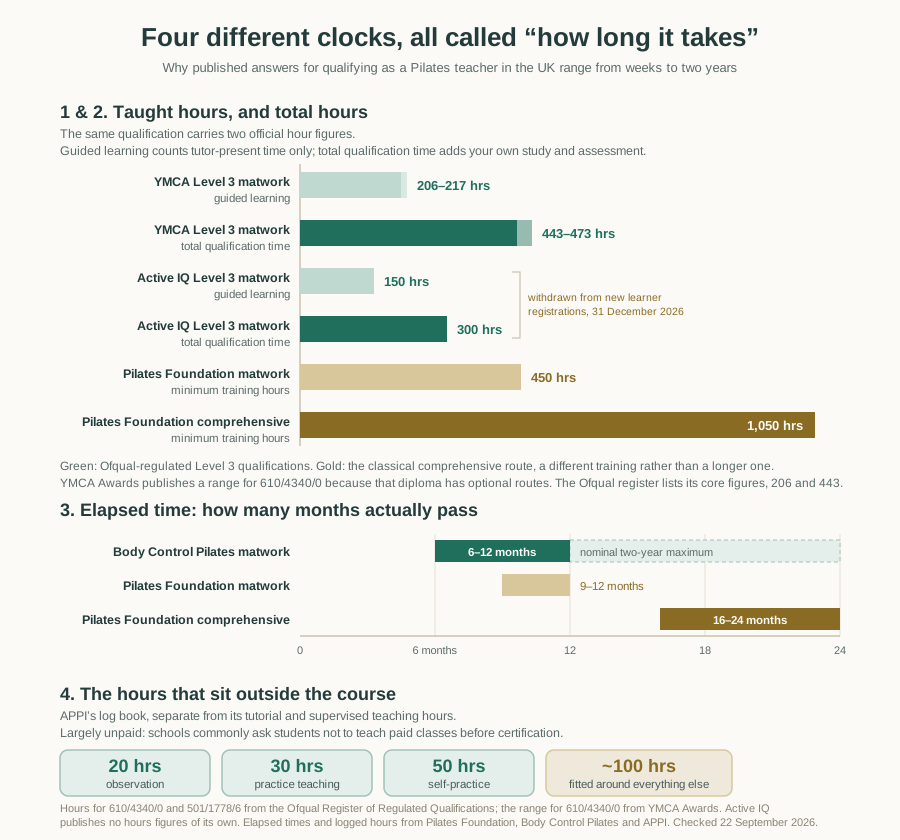
One is the time you spend being taught, with a tutor in the room. Another adds on everything you do at home: the reading, the written work, the assessment. A third is simply the calendar, how many months go by between your first day and your certificate. The fourth is the hours you have to log on your own, watching other teachers and practising on friends and family. Those tend to live in the small print.
Four clocks, all running at once. A page usually quotes one of them without saying which. Separate them and the numbers stop fighting each other.
Why one course has two different hour counts
Most UK courses lead to a Level 3 matwork diploma. Every one of those is listed on a government register you can search for free, and each listing gives two hour counts, not one.
Take the current YMCA Awards Level 3 Diploma in Instructing Pilates Matwork. The register lists it at 206 hours of guided learning and 443 hours of total qualification time. YMCA Awards’ own page gives 206 to 217 and 443 to 473, because the diploma has optional units and different combinations come out slightly different sizes.
Both are right. The smaller number counts only the hours a tutor is with you. The bigger one adds everything you do on your own.
Which means two schools can quote you very different numbers, both honestly, for the same diploma. Nothing on either page would tell you.
So an hours figure on its own tells you almost nothing. Take 370 hours: that same total sits on four different diplomas running today, and on a fifth, YMCA’s older one, which stopped taking new learners in July 2025. Courses get retired and replaced, too. The Active IQ diploma that a lot of commercial courses use stops taking new students on 31 December 2026, and its replacement has the same name.
One question saves you all of this. Ask a course which qualification number it leads to, then look that number up on the register.
The classical route is a different training, not a longer one
The other way in is not a longer version of the first. It is a different training.
Pilates Foundation comprehensive training is at least 1,050 hours over sixteen to twenty-four months. That covers the studio equipment as well as mat, and the observation and supervised teaching are part of the course rather than extra. If you only want mat, their shorter route is at least 450 hours over nine to twelve months.
You can see how little the two worlds think of each other’s measuring at Body Control Pilates. There, the Level 3 certificate is an optional add-on at the end of their own course, and they say plainly that Level 3 asks less of you than their own standard does.
That is not a dig at anyone. The two systems grew up separately, and they are measuring different things.
What actually decides how long it takes you
Less the course itself than the hours you have to fit around it.
APPI spells this out more clearly than anyone. On top of your taught hours, they ask you to log twenty hours watching other teachers, thirty practising your teaching, and fifty on your own practice.
That is a hundred hours, give or take, to find around a job, a family and whenever the studio is actually free.
They are unpaid hours as well. Body Control Pilates asks students who are not already qualified not to teach paid classes until they are certified.
That same school is honest about what really sets the pace: how much time you can give to the supervised teaching, and how you get on with it. Most of their students take six to twelve months, and taking longer is expected rather than treated as failing.
Do you actually need a qualification?
Not by law, as it turns out. Pilates teaching does not appear on the government’s register of regulated professions, and the National Careers Service profile names no Pilates qualification and no awarding organisation.
In practice you will need one, and the reason is insurance. Insurers want to see a qualification recognised by a governing body before they will cover you, and the halls and gyms want to see the insurance before they will have you. We wrote about what that cover includes if that is next on your list.
So, honestly: six to twelve months for a mat qualification if your evenings are fairly free. A year and a half or more if you want the equipment too.
Which one suits you depends on what you would like to be teaching in three years, not on which course finishes first. The money side of it is worth reading alongside this. And when you do come out the other end with a class to fill, taking the bookings is much the smaller problem of the two.
A few things people ask
Do I legally need a qualification to teach Pilates in the UK? No. Pilates teaching is not a regulated profession here, and the government’s register of 281 regulated professions returns no result for it. You will need one in practice, because insurers ask for a qualification recognised by a governing body, and venues ask for the insurance.
Do I need a Level 2 qualification first? Not for the Level 3 matwork diplomas. Individual schools may ask for a period of regular practice as a student first, so it is worth asking.
Is Level 4 longer and harder than Level 3? Harder, not longer. The level describes how demanding the material is, not how many hours it takes. The only Level 4 Pilates qualification currently open to new learners is listed at 80 guided learning hours and 160 total, which is smaller than every mainstream Level 3 matwork diploma on the register.